New research produced by Lichfields in collaboration with the LPDF and Hallam Land, with supplementary data from Landstack, shows that more than half of the sites on England’s brownfield registers have seen no homes built and no planning applications submitted since 2021.
The original Banking on Brownfield report, published in 2022, analysed every site on local authority brownfield registers in 2021. Together, those registers recorded land with an estimated capacity for 1.4 million homes deliverable within 15 years.
Five years on, the new Banking on Brownfield progress report revisits those same sites to test how much of that capacity has turned into homes.
The findings are stark:
Around 220,000 homes have been built on register sites since 2021. Even if that rate were maintained, less than half of the estimated capacity would be delivered within the 15-year window. Over the same period, homes built on these sites amounted to just 12% of the homes needed between 2021 and 2026.
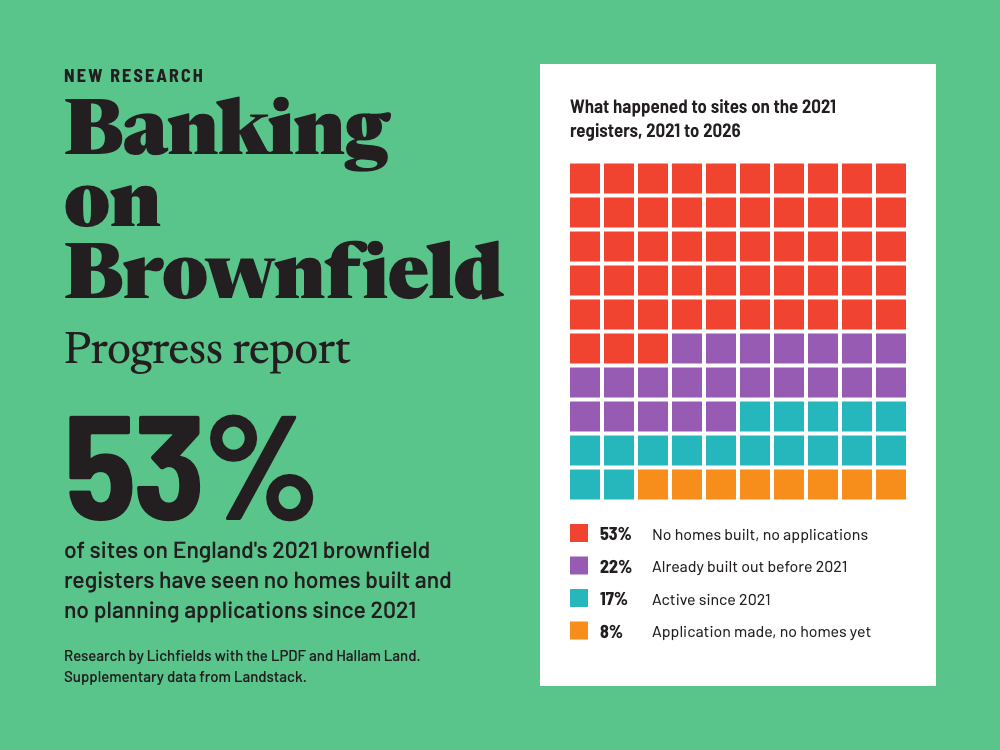
Meanwhile, 53% of sites, with a stated capacity of 610,000 homes, have seen no homes built and no planning applications submitted since 2021. Just 17% of sites have been active, and most of those had already started on site or secured consent before 2021.
Delivery is coming from sites already in the system.
The research shows that brownfield registers have largely recorded land that was already moving through the planning system, rather than bringing new land forward.
Of the homes built since 2021, 83% were on sites that already had planning permission at the date of the register, and a further 15% were on sites with applications submitted before 2021. Just 2,127 homes, around 1% of the total, have been built on sites whose first planning application came after 2021.
Complex sites and overstated capacity.
Brownfield sites are often complex to bring forward. The sites left on the registers tend to be smaller than those already developed, with a median size of 14 homes, and few large sites remain.
Where sites have been built out, the median number of homes delivered is 14 against a median stated capacity of 20, meaning capacity is being overestimated by around 30% on average. Local housing need shows no significant correlation with whether a registered site comes forward, with site-specific factors proving most important.
The picture also varies across the country. Register sites accounted for 25% of net new homes in England between 2021 and 2025, ranging from 11% in the East of England to 45% in London.
A balanced approach to land supply.
Brownfield land has an important role to play, but the evidence shows that registers cannot be relied upon to meet housing need on their own. Delivering the homes the country needs will require a balanced approach that brings forward suitable land of all kinds, including grey belt and greenfield sites, alongside brownfield.
Read the full report.
LPDF is pleased to have worked with Lichfields, Hallam Land and Landstack on this important research. Read the infographic here...